Europe Is Repricing France. That Is Not the Same as Contagion.
Start with the number everyone is quoting. The French 10yr spread to Germany closed Monday at 139 basis points, from 81.5 in August, against a 154 basis point peak in November 2011. It is the widest reading since the euro-area debt crisis. A spread that reaches 90% of its own crisis peak is a story on its own terms, and this site will keep quoting it.
The word attached to it is contagion. That word has a definition. Contagion is not a large spread. It is a large spread that stops being about one country and starts being about the system: funding markets that stop clearing, cross-border bank exposures that get repriced, and a periphery that prices itself rather than the country next to it. None of that is on this tape.
What is on the tape is narrower and more useful. France is being repriced for its own fiscal arithmetic. The periphery is following it rather than leading. The official sector is quiet. This piece draws the line between repricing and contagion, because the two are different trades, and reading one as the other costs money.
What moved, and how far
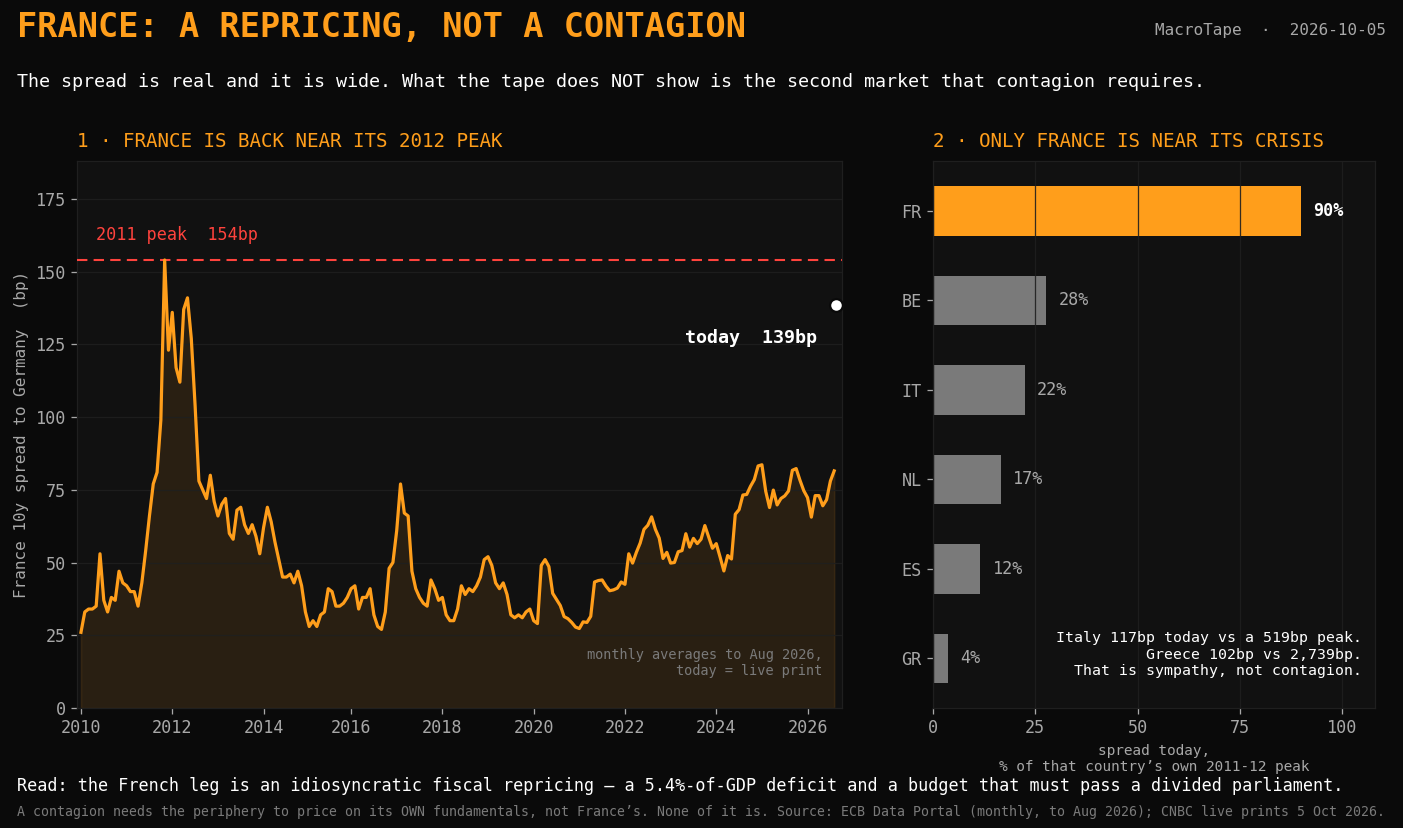
The French 10yr yield closed Monday at 4.85%, the German 10yr at 3.47%. The difference is 139 basis points, up from 81.5 in August. The monthly series the ECB publishes puts August at 81.5 basis points, so the move this column is describing happened in the 2 months since.
The drivers are the ones the market names. France carries a deficit near 5.4% of GDP for 2026, and a 2027 budget with roughly 43 billion euros of savings that still has to survive a divided parliament. Higher yields raise the debt-service bill on the way through. That is a repricing of the issuer's own arithmetic, and it is what a spread is for.
One thing this is not: a currency story. The euro has not been the valve here. The valve is the spread, which is the European leg of a bind this site has written about before, where the borrowing need sets the ceiling on what the central bank can do.
Contagion has a definition. Use it.
When a word describes a market event, it needs a test. For contagion, the test is whether the stress has left the country that caused it and entered the machinery that prices everything else.
Three channels have to show it. Funding: banks and dealers stop lending to each other against that sovereign's paper. Cross-border exposure: lenders in one country take losses on another country's debt. Self-pricing: the periphery's spreads move on its own news, not simply because it trades near the country at the centre.
A 139 basis point spread is a fiscal story. A contagion is a payments story. The distinction is not academic, because the policy response to one is to do nothing and to the other is to do everything.
The periphery is not pricing itself
Here is the test that matters most, and it fails. Italy's spread to Germany is 117 basis points, against a 519 basis point peak in November 2011: 23% of its own crisis. Spain is 64 against 555, or 12%. Greece is 102 against 2,739, or 4%. Belgium is 82 against 297. The Netherlands is 11 against 67.
Those countries are widening alongside France. That is sympathy, not contagion. They are correlated beta to a French event, not independent funding stress. When Italy prices 117 basis points while its own crisis peak was 519, the market is not repricing Italy. It is repricing France and charging a little extra to hold the neighbours.
The channel to watch is narrower than the headline. If BTP-Bund starts moving one-for-one on French headlines while Italian fundamentals are unchanged, then the periphery is being priced for Paris's politics. That is the moment the word fits. It has not happened yet.
Why the ECB is right to sit still
The European Central Bank has a tool built for this and has not reached for it. The Transmission Protection Instrument exists to counter what it calls unwarranted, disorderly tightening of financing conditions. Activation carries conditions, including a sound fiscal path.
France is under an excessive-deficit procedure. The widening is driven by fiscal and political facts the market can name. That makes it warranted in the ECB's own vocabulary, and warranted is the case where the instrument is not supposed to fire. The bond-buying tools, Bundesbank president Joachim Nagel has said, prioritise price stability over targeting a particular spread. No official has signalled a TPI activation for France, and the asset-purchase runoff continues.
That is not the ECB being asleep. It is the instrument working as designed: a repricing driven by fundamentals is the market doing its job, and the central bank is supposed to let it.
The quiet official sector is the signal
If there is one channel that moves faster than any market toward a crisis, it is the official sector. Central banks and the IMF do not wait for confirmation. When funding really stops clearing, they are on the wires before the spread has finished widening, because their job is to be early.
Right now that channel is silent. The ECB is on message, the IMF is calm, and the Bundesbank has not found a microphone. A quiet Bundesbank says more than a loud one. When it is making noise, the contagion word is earned.
So the read is impatience, not contagion. The bond market is leaning on the long end and on the weaker sovereigns, and the front end and the institutions are refusing to follow.
What would change the read
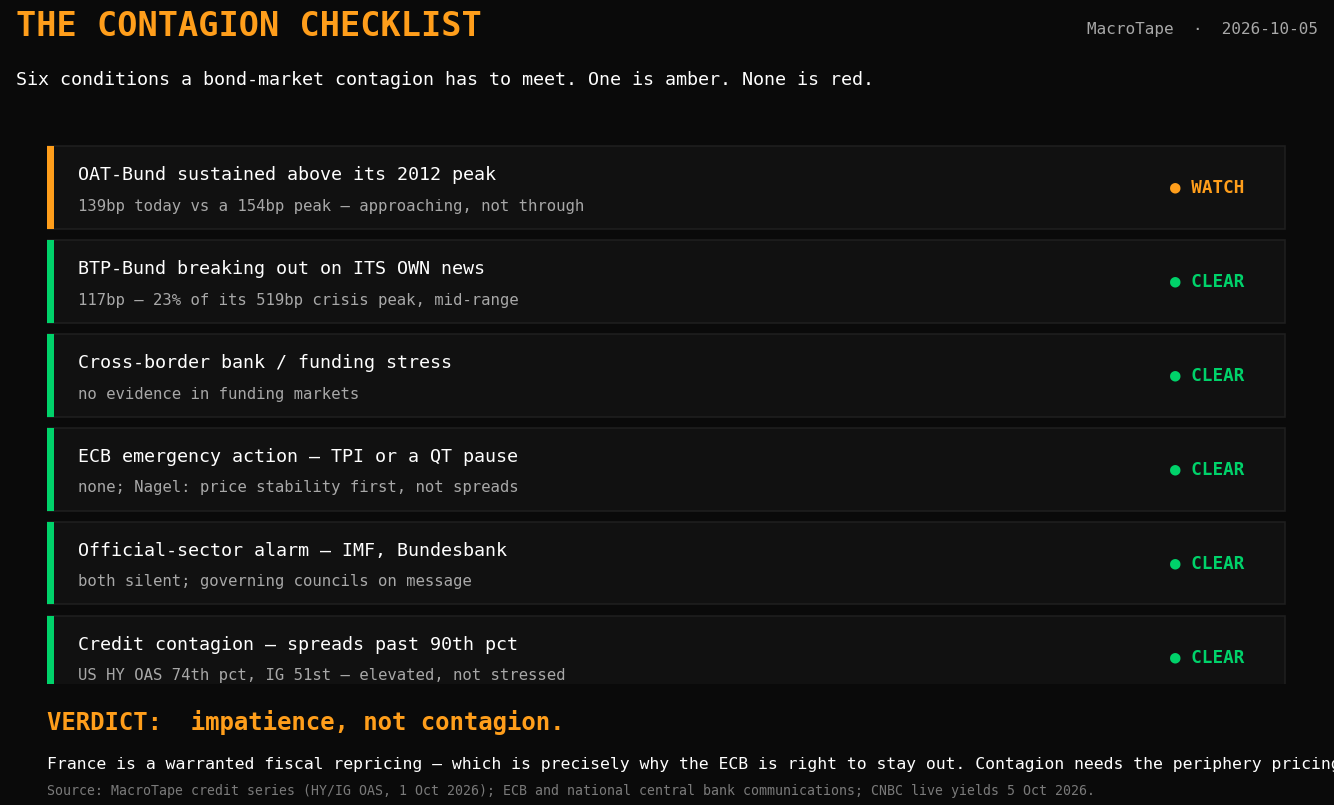
Six conditions would turn a French repricing into a European contagion. French spread sustained above its 2012 peak. BTP-Bund breaking out on Italian news. Cross-border funding stress. An ECB emergency response. Official-sector alarm. Credit spreads past the 90th percentile of their range.
On Monday one of the six was amber. The United States high-yield spread, the cleanest credit thermometer, sat at 3.24%, the 74th percentile of its 3yr range. That is elevated, not stressed, and investment-grade credit at 0.86% is barely above the middle of its own. The other five conditions were clear.
The honest summary is a market doing exactly what a market does when a sovereign's arithmetic gets worse. France's spread is a legitimate story and it belongs on these pages. The headline the tape does not support is the one that calls it a crisis.
Where the Risk Lives Now — the earlier map of where stress does and does not sit across markets
What HY OAS Actually Measures — the credit thermometer quoted in the evidence line, explained
Duration — why a small spread move is a large price move in a long bond