Everyone Agreed Except the Bond Market
Four markets finished the week agreeing. Shares went up. Credit spreads stayed near their tightest levels in years. Oil fell. Gold fell. Read only those four and the week was calm and slightly good. The fifth market disagreed. The 30yr Treasury yield closed at 5.49 per cent, the highest in more than 2 decades, and the 10yr at 5.17. Yields rising is not automatically bad news - it usually means growth, and growth is supposed to be good. What makes this week worth writing about is where the two ends of the curve now sit relative to each other, and relative to everything else. The price of money has been repriced to the top of its range. Nothing that measures fear has moved at all. This piece is about that gap, why it is wider than it has been in years, and what it takes to close it.
Closing time in a week where nothing happened
It is Saturday. There is football on the television and neither of them is watching it.
The Blazer has had a quiet week and he does not trust it. Nothing broke. Nobody blew up. He has spent 5 days waiting for the thing that usually happens, and it did not happen, and a man like the Blazer takes that personally.
The Second Opinion has the opposite problem. He read the same 5 days and found something he cannot put down, which is the sort of thing that ruins a perfectly good weekend.
The Blazer reads the tape and finds nothing wrong
The Blazer: Look at it. Shares are near a record. Credit is so calm you could fall asleep in it. Oil is down seven dollars on the week, which is money back in people's pockets, and inflation is coming off its highs. There is nothing here. If there were a problem, the credit market would find it first. The credit market has not moved.
The Second Opinion: That is four markets.
The Blazer: What?
The Second Opinion: You have described four markets. There are five. I mention it only because you were so confident.
The Second Opinion points at the one that is unhappy
The Second Opinion: The long bond. Five point four nine on the 30yr. The highest reading of the whole sample. And the 10yr at five point one seven, which is also the highest.
The Blazer: So the long end is expensive. Fine. The long end is always expensive.
The Second Opinion: That is the wrong end of the sentence. It is not the long end. It is the whole curve. The 2yr is at four point eight one, and the rate the central bank actually sets is three point nine. The front end is sitting 91 basis points above it.
The Blazer: Which means?
The Second Opinion: Which means the market is not pricing relief. It is pricing this to last. You do not pay above the administered rate because you think the pain is nearly over.
The Blazer: Then why is nobody worried?
The Second Opinion: That is the piece. High yield spreads are at two point seven three, the seventeenth percentile of their own history. Investment grade at zero point seven seven, the fourteenth. The fear index closed at fourteen point eight seven, which is the ninth percentile, meaning it has been higher than this roughly nine times in ten.
The Blazer: So the fear index is asleep.
The Second Opinion: Every instrument whose entire job is to measure worry is near the bottom of its range, and the price of money is at the top of its. They cannot both be right, and only one of them has to be wrong for the other one to be expensive.
Then somebody brings up the diesel
The Blazer: Fine. But the White House spent the week trying to bring down the price of diesel. In an economy you say is running hot. Those two things cannot both be the plan.
The Second Opinion: Three positions in 4 days. Announced on the Tuesday. Denied on the Thursday. Voluntary by the Friday. I have seen people change their mind less often while being arrested.
The Blazer: So it never happened. Rhetoric. Nobody serious believed it.
The Second Opinion: It moved the price before it was denied. That is the part I keep coming back to. You can make something scarce by saying so, and unmake it by saying so. Nothing else in the world works like that. Try it with copper. Stand in the street and announce that there is more copper now, and see who salutes.
And then there is the bill that never stops arriving
The Second Opinion: There is a second thing from this week that nobody has priced. A bank put out a table on the artificial intelligence buildout. Everybody read it as a warning that the spending might not pay off.
The Blazer: And it might not. Half of it is a chatbot that writes emails badly and gets thanked for it.
The Second Opinion: That is not what the table says. It says that even in the worst case, the case where none of it earns anything at all, the companies still have to spend most of a trillion dollars a year, forever, just to stand still. The frightening part is not that the money is wasted. It is that the bill arrives either way.
The Blazer: That is depreciation.
The Second Opinion: Yes. Which is the running cost of a machine wearing a suit. A data centre is not a thing you own. It is a subscription you cannot cancel, sold to you by people who call it an asset. The accountants agreed, which is the whole trick.
The Blazer: We just need time.
The Second Opinion: Time is free when you are watching. It is expensive when you own the fleet. The bill does not care which of us is doing which.
Where everything sits
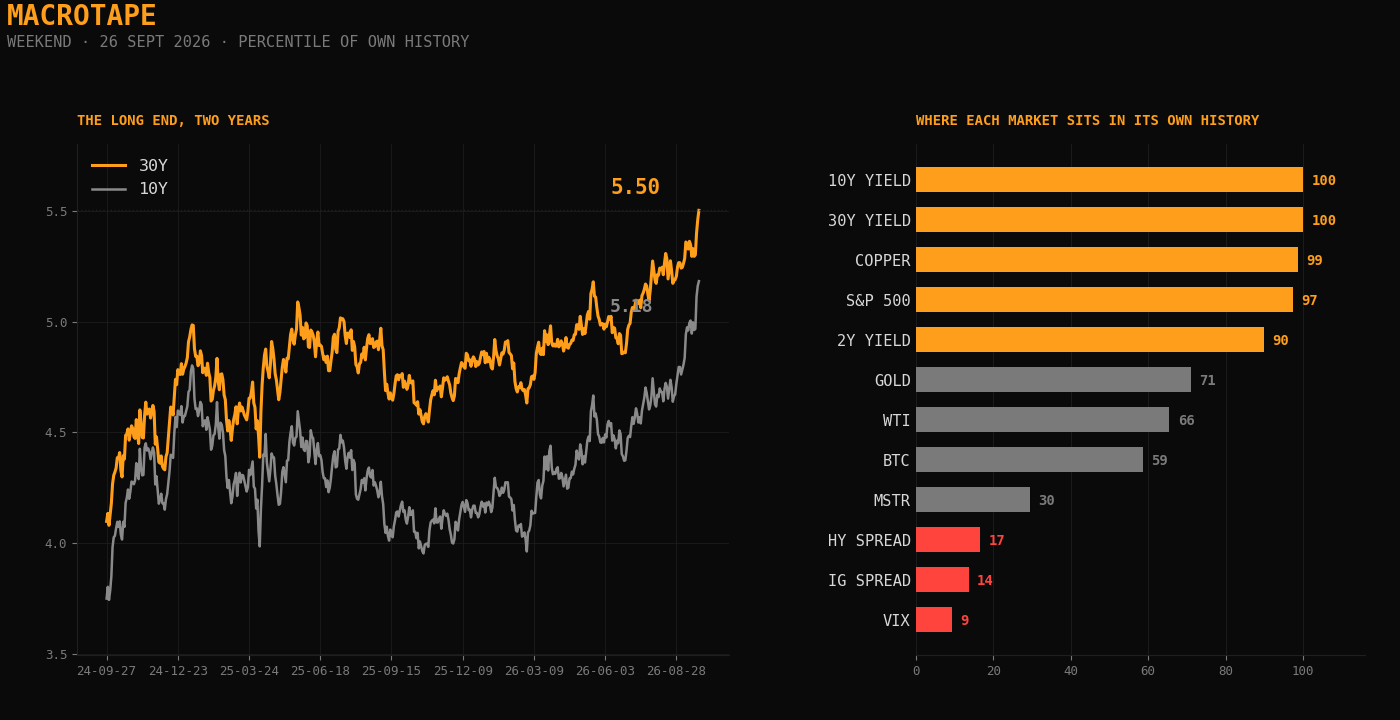
The picture is the argument. On the left, the long end over 2 years, finishing at the highest level in the sample. On the right, every market placed against its own history. The yields and the asset prices are stacked at the top. The two credit spreads and the fear index are at the bottom, which is where they sit when nobody expects anything to go wrong.
What the tape actually did
The 30yr closed at 5.49 and the 10yr at 5.17, both the highest readings in the sample. The 2yr at 4.81, 91 basis points above the rate the central bank sets. All three yields rose over the week, the 10yr leading the way by 24 basis points, so this was a broad repricing rather than a twist at one end of the curve. The gap between the 2yr and the 10yr is 29 basis points, which is narrow enough that the curve is barely doing any work anywhere along it.
Nothing below the curve joined in. High yield spreads sat at 2.73 and investment grade at 0.77, untroubled. The volatility index closed under fifteen, which is roughly where it sits when nothing is happening and exactly where it sat in the week before several things happened. The S&P finished at 7,743, not far off a record. Oil fell to 92.41, down more than seven dollars on the week. Gold gave back 113 dollars to close at 4,321, which its owners will be describing as consolidation.
What next week is actually about
Two things. Whether the diesel measures become a signed order or stay a sentence. And whether credit ever agrees with the long end.
The Blazer: So you are telling me to buy bonds.
The Second Opinion: I am telling you that the long end is the only market pricing a problem, and that it is not pricing yours.
The Blazer: That is not an answer.
The Second Opinion: No. It is a summary.
| INSTRUMENT | LAST | 1D Δ | 1W Δ | Z (3Y) |
|---|---|---|---|---|
| VIX | 17.20 | +0.29 | +0.23 | -0.09 |
| MOVE | 93.54 | -1.01 | -1.39 | +0.14 |
| DXY | 101.78 | -0.26 | +0.63 | +0.15 |
| USD/JPY | 157.42 | -0.41 | -0.29 | +0.94 |
| GOLD | $4,003 | -28 | -22 | +0.75 |
| COPPER | $6.551 | -0.029 | +0.294 | +1.92 |
| WTI | $103.28 | +1.28 | -2.90 | +2.06 |
| BTC | 78,069 | -3,199 | -633 | +0.08 |
| ETH | 2,238 | -119 | -34 | -0.61 |
| MSTR | 141.62 | -3.54 | -8.32 | -0.53 |