Two Men, Three Drinks, and 2.6 Per Cent for Certain
For most of the past decade a safe bond paid nothing once inflation was taken out of it. That has changed. A 5yr US Treasury note pays 5.01 per cent, and a 5yr inflation-protected bond pays 2.65 per cent on top of whatever the price index does. That second number is a real yield, and 2.65 per cent of it is the most a safe dollar has paid in real terms in years. The gap between the two, 2.37 percentage points, is the break-even: the inflation rate at which the plain bond and the inflation-linked bond pay the same. Buy the inflation-linked one and you are betting the price index runs above that line. The arithmetic is easy. What two men in a pub cannot agree on is what the bet is against. One of them is buying inflation cover. The other is buying a Treasury. Those are not the same thing, and the whole argument lives in the gap between them.
Closing time in a week the long end finally moved
It is Saturday. There is football on the television and neither of them is watching it.
The Blazer has had a good week and does not trust it. He bought bonds on Thursday, which he does roughly twice a year, and for once the trade went his way inside a day. A man like the Blazer treats a working trade the way other men treat a compliment from a stranger: he assumes something is being sold to him.
The Second Opinion has spent the afternoon reading a note from Jurrien Timmer, who runs global macro at Fidelity. He has read it three times and cannot decide whether it is the most honest piece of bond research of the year or the most carefully hedged. He suspects both, which is why he has ordered a fourth drink.
The Blazer reads the yield and gets the easy part right
The Blazer: Five per cent. On a 5yr Treasury. You lend the safest government on earth money for 5 years and it pays you five per cent a year, guaranteed. I do not need a chart for that. The yield is the story.
The Second Opinion: The five per cent is nominal. It is not what you get. Nobody keeps the whole five per cent, because prices move underneath it.
The Blazer: Then what do I get.
The Second Opinion: Two point six five per cent. That is the real yield on the 5yr inflation-protected note, as of October the first. Two point six five per cent over and above inflation, and it is priced off the market's own curve, not a model. The plain note pays five point zero one. The gap between them, two point three seven points, is the break-even. That is the inflation rate at which the two of them pay the same.
The Second Opinion does the arithmetic and finds the gap
The Second Opinion: Here is the part you have not read. The market is pricing two point three seven per cent inflation over the next 5 years. That is the break-even, as of October the second.
The Blazer: Which means the market expects two point four per cent. Fine. That is near enough to target. What is the trade.
The Second Opinion: It means the market expects two point four per cent. What it is actually printing is higher. Headline CPI ran three point three five per cent year on year in August. Core, which strips food and energy, ran two point four five. Core PCE, the measure the central bank watches, ran three point zero one. Every one of them is above what the bond market is charging for.
The Blazer: So buy the inflation-linked one.
The Second Opinion: That is what Timmer concludes, and for once I think he is right and saying so plainly. He calls the break-even too low and the real yield compelling, and he says his base case is that the three-to-four per cent regime of the last 5 years is here to stay. I would only add the part he admits in the same breath. This is not a free option. If inflation comes in below two point three seven, you lose to the plain bond, and the entire disinflationary case, which is every recession worth the name, sits in that region.
The Blazer: Then why is anybody in it.
The Second Opinion: Because two point six five per cent real is a lot to give up for a forecast you are not sure of.
Then somebody brings up the printing press
The Blazer: You are both missing it. This is the same argument as the debt. Forty point two six trillion dollars outstanding, as of October the first. Interest cost nine hundred and seventy billion in the last full fiscal year. Somebody said this week that inflation pays the debt down. If that is the plan, you buy the inflation-linked bond and you stop thinking.
The Second Opinion: Two things. First, that arithmetic is slower than it sounds. The average Treasury matures in about 6 years, so inflation only reaches the whole stock as it rolls. Second, and this is the part that matters: the inflation-linked bond is still a Treasury. You are not hedging the sovereign. You are buying more of it, with a coupon that moves.
The Blazer: I do not follow.
The Third Man, from the end of the bar: He means you have bought cover against the ruler, not against the government. The inflation-linked bond pays you more when the price index rises. It does nothing if the market decides the sovereign is a worse credit and demands a higher real yield for the same paper. Those are two risks, and only one of them pays you.
The Blazer: So what does the other one look like.
The Third Man: The 30yr. It closed at five point six one per cent on Thursday, the highest in 2 decades. That is not a view on the next CPI print. That is the price of lending to a government for 30 years going up because the lender is less sure it gets repaid in money that holds its value. Your inflation-linked note is a 5yr. It is the point on the curve furthest from that fight. That is why I do not hate it. But do not call it a hedge. Call it a good real yield and a bad conversation with reality.
The Second Opinion: Then what is the hedge.
The Third Man: The things that are not anybody's liability. Gold. Bitcoin. The assets with no issuer to disappoint you. The inflation-linked bond is the compromise. A real return from a borrower you are already worried about.
What the tape actually did
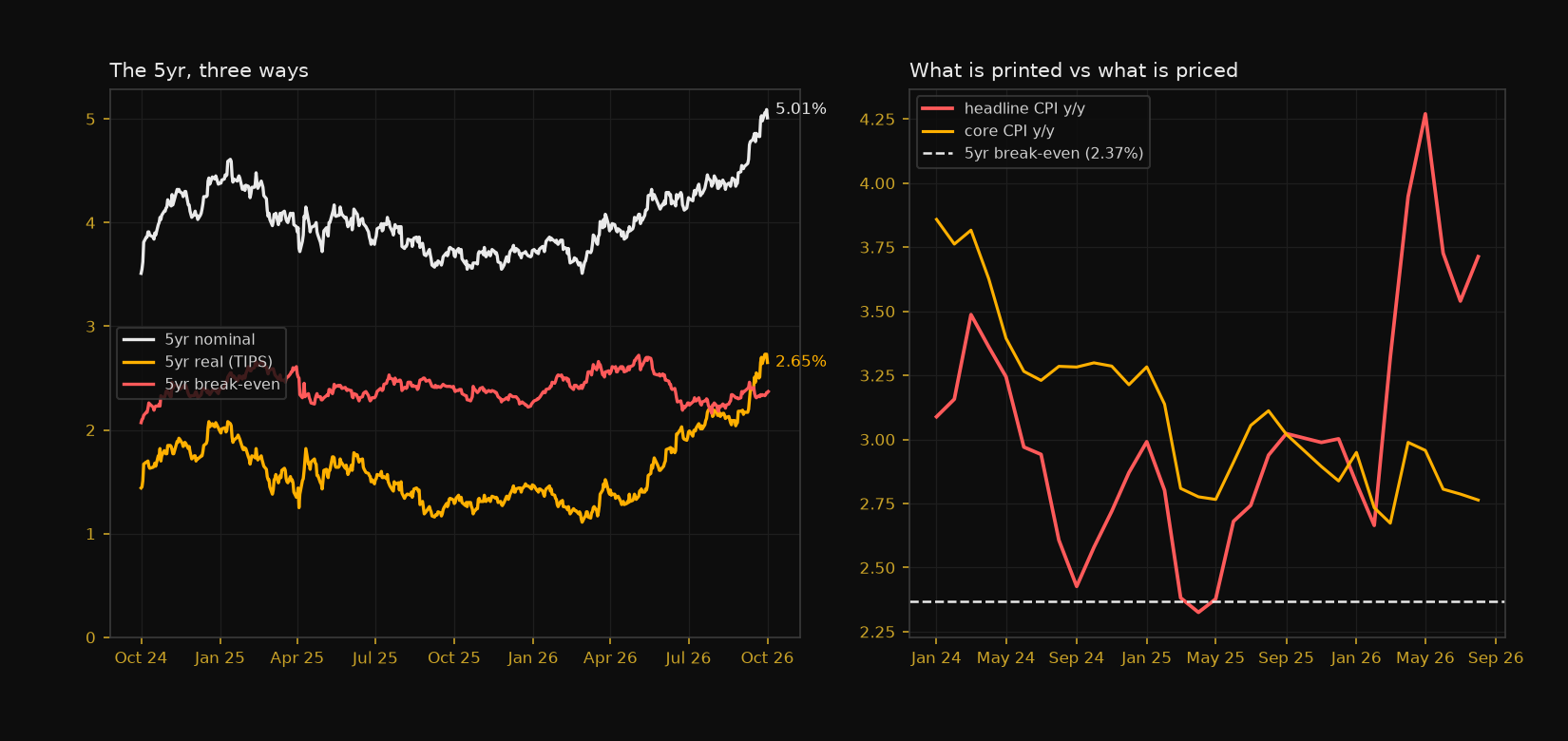
The picture is the argument. On the left, the three ways to own the same 5 years: the nominal note, the inflation-linked note, and the market's own estimate of the distance between them. On the right, what has actually printed against what is priced, and the gap does not close.
The 5yr Treasury note closed at five point zero one per cent on October the first. The 5yr inflation-protected note closed at two point six five per cent real. The 5yr break-even, the market's own estimate of inflation over that horizon, closed at two point three seven per cent on October the second. All three from the government's own curve and the central bank's published series.
Further out it sharpens. The 10yr note sits at five point two four, the 30yr at five point six one, which is the highest reading in 2 decades. The gap between the 2yr and the 10yr is 46 basis points, narrow by any historical standard. Every one of those yields sits in the high nineties of its own history, meaning a reading this high has been seen on fewer than 1 day in twenty.
And underneath it, the inflation the bond market is charging for is lower than the inflation already printed. That is the whole piece. The market is not pricing a crisis. It is pricing a central bank that will not be allowed to win, and charging you less than it should for the privilege of disbelieving it.
The hard asset read
Gold closed the week at 4,162.30 dollars an ounce, down 100 dollars on the week, having spent it being sold to fund higher real yields. Bitcoin sits at 84,574, up more than 1,500 on the week. Both are the assets the Third Man pointed at, and neither behaved like a crisis hedge this week. That is the honest read. This is a repricing of the discount rate, not a flight to safety.
Which is the point. The inflation-linked bond is not a bet that the world ends. It is a bet that the words real yield mean more than the words inflation will be contained. At two point six five per cent, that bet pays you to wait for the answer. The only question is whether the answer arrives before the 30yr decides it has one of its own.