Two Men, Nine Barrels, and the Four-Tenths of a Per Cent
Oil rallied hard this week, and the headline number is easy to misread. The barrel for delivery next month went from 91 dollars 85 to 101 dollars 41, a move of 10.4 per cent in 5 sessions. But a barrel is not one thing, it is a date, and the futures market prices every date separately. Read the ladder from November 2026 out to December 2032 and the week looks different: the gain falls from 10.4 per cent at the front to 0.4 per cent 6 years out. That gap is the whole argument. A market pricing durable inflation would pay up for the far barrels, because that is where a change in the regime has to show. This one paid for the winter and left 2032 alone. The same test applied to gold, copper and bitcoin gives the same answer: their 2027 contracts trade at the cost of carry, roughly the bill rate, not at a premium for a changed world. What follows is two men and a third who says very little, working out whether the front of the curve is telling the truth about the back.
Closing time, and a man with a phone
It is Saturday, the football is on with the sound down, and the Blazer has a phone in his hand and a look on his face that the other two have learned to dread.
He has found a post from Jeffrey Currie, who ran commodities research at Goldman for years and now writes for himself. The post says the macro repricing of energy is underway, points at the move in long dated oil, and tells the reader to get long and buckle up. The Blazer has read it four times and has already decided it is the most important thing anyone has said all year.
The Second Opinion has not read it. He has spent the afternoon with the futures ladder open on a laptop, which is what he does when he wants to argue with someone who has not arrived yet. The Third Man is at the end of the bar and has said nothing, which in his case is a form of agreement and a form of warning at the same time.
The Blazer reads the post and sees inflation
The Blazer: Here. Read it. Long dated oil. That is not a spike, that is the whole curve. The man says it is structural, and he is not some kid with a chart, he ran the desk at Goldman.
The Second Opinion: I read it. He is right about the tape and he is careful about the words. He says long dated oil moved strongly. He does not say which contract.
The Blazer: What difference does that make. Oil is oil.
The Second Opinion: It makes all the difference in the world, because a barrel is not a thing, it is a date. A barrel for November is a barrel you can have in 3 weeks. A barrel for December 2032 is a promise about a world with a different fleet, a different OPEC, and probably a different set of men running it. When someone says the curve moved, the first question is always: which part of it.
The Blazer: Fine. Which part of it.
The Second Opinion builds the ladder and finds the decay
The Second Opinion turns the laptop around, which he has been waiting all afternoon to do.
The Second Opinion: Here is the ladder, from Friday's close. November 2026 is at 101 dollars 41. It was 91 dollars 85 a week ago. That is a move of ten point four per cent in 5 sessions, on a contract that settles in about a month. December 2027, the one the post is really pointing at, is at 80 dollars 54. It was 77 dollars 39. That is four point one per cent. December 2028 is up two point five. December 2029, one point seven. December 2030, one point one. December 2031, six-tenths of one. December 2032, four-tenths.
The Blazer: So it all went up.
The Second Opinion: It all went up, and the amount it went up falls by roughly half at every step out. The market paid a 10 per cent premium for the next 12 months and a 0.4 per cent premium for the next 6 years. That is not a repricing of energy. That is a repricing of this winter, with a small nod to the year after.
The Blazer: But the 2027 barrel is at 80 dollars 54, and that is an all-time high for that contract. It has been trading since 2018. It has never been this expensive.
The Second Opinion: True, and worth sitting with. The December 2027 contract has never printed higher than it did on Friday. But an all-time high for a contract is not the same as an all-time high for a commodity, and this is the trap the post sets for a reader in a hurry. The December 2032 contract is at 57 dollars 81. In April 2022 it was at 70 dollars 21. The barrel 6 years out is still 12 dollars 40 below where it traded when the world was actually short.
The Blazer: That is because nobody can see 2032. It is a lottery ticket with a clearing price.
The Second Opinion: Agreed. Which is exactly why it is the honest number. The front is a forecast about tankers and terminals. The back is a forecast about geology and capital. The back has not moved. If inflation is going to be durably higher for years, the back is where it should show up first, because that is the contract nobody is hedging a cargo against.
The Third Man asks what the bond market did
The Third Man, without looking up: What did the bond market do.
The Blazer: What has the bond market got to do with it.
The Third Man: Everything, because the bond market is the only room in the building where people are paid to be wrong out loud, in public, daily. Crude went up 10 per cent in a week. If that were an inflation shock, the 10yr break-even would have widened. It is at 2.35 per cent. A week ago it was 2.33. 2 basis points, on a 10 per cent move in the price of the world's most important input. The 5yr is at 2.37 and the 5yr, 5yr forward, which is the market's estimate of inflation from 2031 to 2036, is at 2.33. All three have been flat for a fortnight.
The Second Opinion: And the real yield fell.
The Third Man: The real yield fell. The 10yr nominal went from 5.24 to 5.09 in a week. The 10yr real went from 2.91 to 2.78. The whole of that fall was the real component, because the break-even did not move. So while the front of the oil curve was repricing 10 per cent higher, the bond market was cutting the real cost of money by 13 basis points.
The Blazer: Which means what.
The Third Man: It means the bond market did not read this week as inflation. It read it as a hit to growth, with the central bank eventually having to respond to that hit. An inflation shock pushes break-evens up and real yields up together. This was real yields down, break-evens flat. That is the signature of a supply disruption dragging on activity, not of a regime where money stops working.
The Blazer: Then why are the energy stocks at all-time highs.
The Third Man: Because energy equities are a claim on the front of the curve, not the back. Exxon closed at 178 dollars 98 on Friday, Chevron at 224 dollars 99, the energy sector ETF at 68 dollars 24. All three records, all three set on the same day. A producer selling 2027 oil at 80 dollars with a 10 per cent prompt premium is printing money. That does not make the 2032 barrel expensive. It makes the front barrel profitable.
Then they price gold, copper and bitcoin the same way
The Second Opinion: Which brings me to the part I actually wanted to show you. If the thesis is that inflation is durably here, then every hard asset's 2027 curve should be paying you to own it. So I priced them the same way.
He turns the laptop again.
The Second Opinion: Gold is 4,166 dollars an ounce spot. The December 2027 future is 4,394 dollars 60. That is 5.48 per cent over 14 months, or 4.58 per cent a year. Silver, 57 dollars 30 spot against 60 dollars 34 for December 2027, 4.42 per cent a year. Copper, 6 dollars 53 against 6 dollars 97, 5.56 per cent a year. Bitcoin, 81,462 on the perpetual against 85,522 for September 2027, 5.33 per cent a year.
The Blazer: So they are all going up. That is the inflation.
The Second Opinion: They are all going up by almost exactly the same amount, and that amount is the 3-month bill, which pays 4.10 per cent. These are not inflation forecasts. They are financing costs. When you buy a December 2027 gold future you are not buying a view that gold is worth more in 2027. You are paying somebody to store it and finance it for 14 months, and the price you pay is the risk-free rate plus a sliver of storage and insurance.
The Blazer: Then why is the copper number the highest.
The Second Opinion: Because copper costs more to store and insure, and because the market is telling you it expects more copper in 2027 than it can use, not less. A contango above the cost of carry means supply is expected to arrive. That is the opposite of a scarcity premium. Our own note 2 weeks ago said copper had broken to a rank high on the spot. The 2027 curve says the spot is the scarce thing and the future is not.
The Blazer: And bitcoin.
The Second Opinion: Bitcoin is the cleanest of the four, because it has no storage cost and no insurance and no warehouse. Its September 2027 future trades at 5.33 per cent a year over the perpetual. That is the market's price for carry, and it is the highest of the four. If you want to own bitcoin for the 2027 inflation, the futures market will charge you 5.3 per cent a year for the privilege, which means the asset has to beat the bill rate by that much before the trade is even flat.
The Third Man: Which is the whole answer, and it fits in a sentence. The 2027 curve across every one of these assets prices carry, not catastrophe. There is no term premium anywhere in the complex for the world the post describes.
What the tape actually did
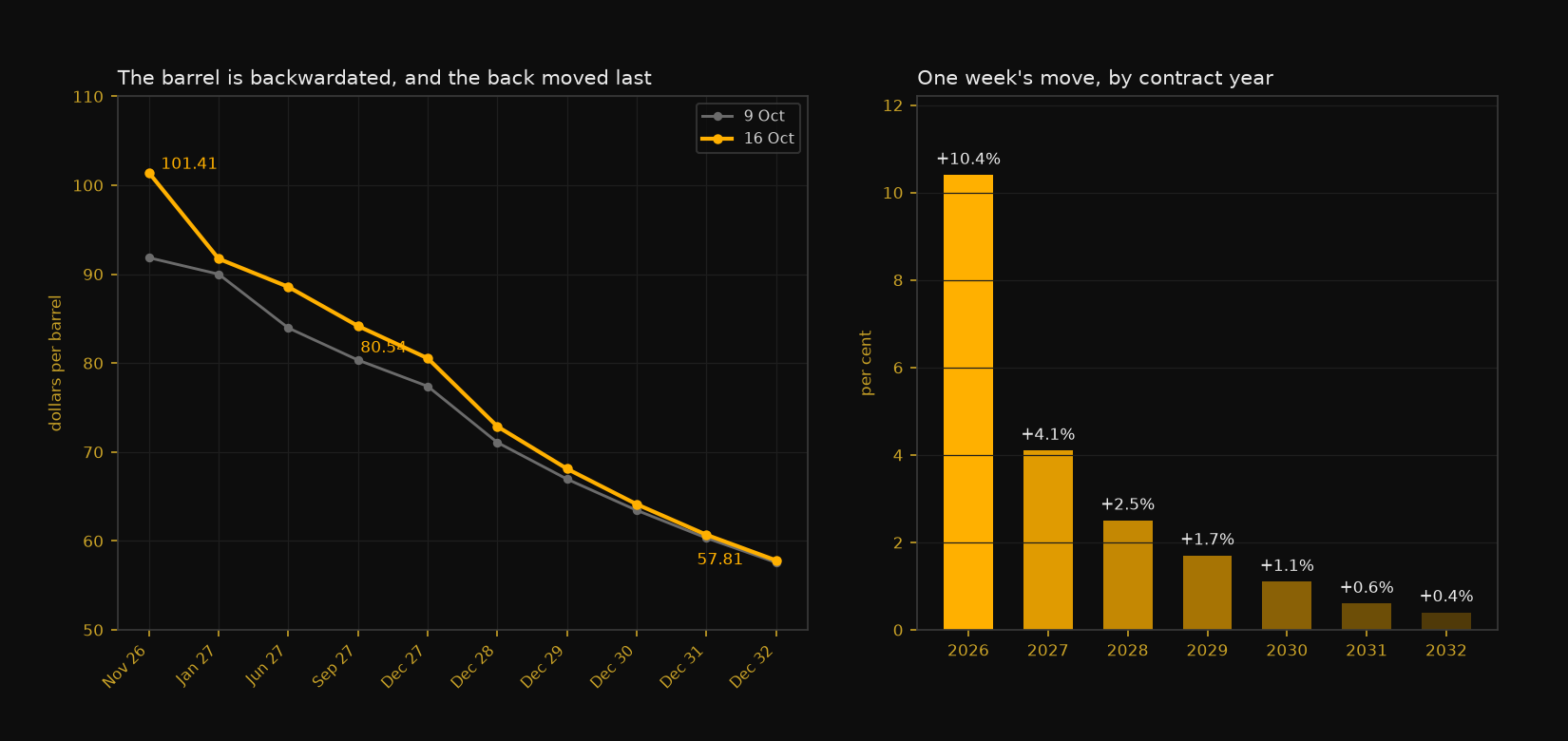
The picture is the argument. On the left, the ladder, twice. On the right, the same week expressed as a percentage, by the year the barrel is delivered. The bars fall almost in a straight line.
Friday's close: November 2026 at 101 dollars 41, up 10 dollars 44 on the week. December 2027 at 80 dollars 54, up 3 dollars 15. December 2028 at 72 dollars 87. December 2029 at 68 dollars 11. December 2030 at 64 dollars 12. December 2031 at 60 dollars 69. December 2032 at 57 dollars 81, up 24 cents.
The spread between the front and December 2032 is 43 dollars 60, the widest since March 2022, when prompt crude briefly carried a 59 dollar 56 premium over the same back contract on the day Russia invaded. Brent's December 2027 sits at 86 dollars 69 against WTI's 80 dollars 54 on the same delivery month, a 6 dollar 15 gap that is a freight and quality story, not an inflation story.
Underneath, the monetary leg is quiet. The 2yr par yield closed at 4.74, the 5yr at 4.89, the 10yr at 5.09 and the 30yr at 5.43. The 30yr is 18 basis points below where it sat on 9 October. The long end, which spent September pricing the issuer, spent this week relaxing while oil screamed. Whatever happened this week, the bond market did not treat it as a reason to demand more compensation for holding a 30yr claim on the US government.
And the inflation that already printed is above what is priced. Headline CPI ran 3.72 per cent year on year in September, core ran 2.57. The 10yr break-even charges 2.35. That gap has been open for months and it did not close this week either.
What would prove it, and what would break it
The Blazer: So you are telling me the man is wrong.
The Second Opinion: I am telling you he is early, or he is right about a smaller thing than the post implies. He said the repricing is structural. Structure lives in the back of the curve, and the back of the curve moved 0.4 per cent. What actually repriced is the front, and the front reprices on tankers, on Hormuz, on whether a refinery in Asia gets its cargo. That can be structural for a season and gone by spring.
The Third Man: And there is a version where he is completely right and the tape is just slow. If the tightness does not resolve, the front stays bid, the market gets tired of rolling short, and eventually the 2029 and 2030 contracts have to reprice because the replacement cost of a barrel has changed. That is a story about capital expenditure, and the honest way to say it is that no producer is going to spend 2027 money at 57 dollars a barrel for 2032 delivery. If the back end stays here, supply does not come, and the back end is wrong. That is the trade.
The Blazer: Then buy the back. It is the only thing that has not moved.
The Third Man: Now you have said something worth arguing about. Buying December 2030 and 2032 is the only expression that pays if the thesis is durable rather than seasonal, because you are buying the contracts the crowd has not touched. It is also illiquid, it is a 6yr promise with no cargo behind it, and you will carry it through a year where the front could halve and drag the back down with it. That is not a free option. It is a long-dated disagreement with a market that has already voted.
The Second Opinion: Which is why the cleanest way to hold the view is the spread, not the level. Long December 2030 against short November 2026 is a bet that the front is a squeeze and the back is the truth. It pays whether oil goes to 70 or 120, as long as the shape normalises. What it does not pay is a world where the front stays at 100 into 2027 and the refineries keep paying it.
The Third Man: And bitcoin and gold stay where they are, doing their carry trade, pretending to be hedges.
The Second Opinion: They are not pretending. They are doing exactly what they should. Gold at 4.58 per cent a year and bitcoin at 5.33 are telling you that the market will hold your inflation insurance for you, at the price of money, and not a penny more. That is not a market pricing a durable inflation regime. That is a market pricing a durable financing regime, which is a much more boring and much more likely thing.
The Blazer: So what do I write on the napkin.
The Third Man: Write this. The front is priced for a war. The back is priced for peace. Somewhere between 101 dollars and 57 dollars is what actually happens, and the only edge in the whole complex is that nobody has made up their mind yet.