Bitcoin Was Never a Rates Trade. The Credit Market Has Not Noticed.
There is a trade in bitcoin that does not require a view on the price. It pays close to fourteen per cent, it is priced daily by the market rather than argued about on television, and the collateral behind it can be counted by anyone with an internet connection and a block explorer. That is a credit argument, and credit desks understand credit arguments.
This piece sets out four things the market has been slow to price. Three of them are measurements: how much the asset's volatility has fallen, how much new supply the listed funds are absorbing, and how weak the link to the bond market turns out to be once it is actually tested. The fourth is a spread, and a spread is the only one of the four that can be underwritten without forecasting anything.
Every figure carries its window and its source, the bear case is in the same document rather than bolted on at the end, and the one number we could not reconcile is stated as such.
The volatility collapsed and nobody resized
Bitcoin's 30-day realised volatility is 41.5% annualised. That is the 26th percentile of its own history measured back to 2014, against a median of 54.1% across that period. In 2017 the same measure ran at 94%.
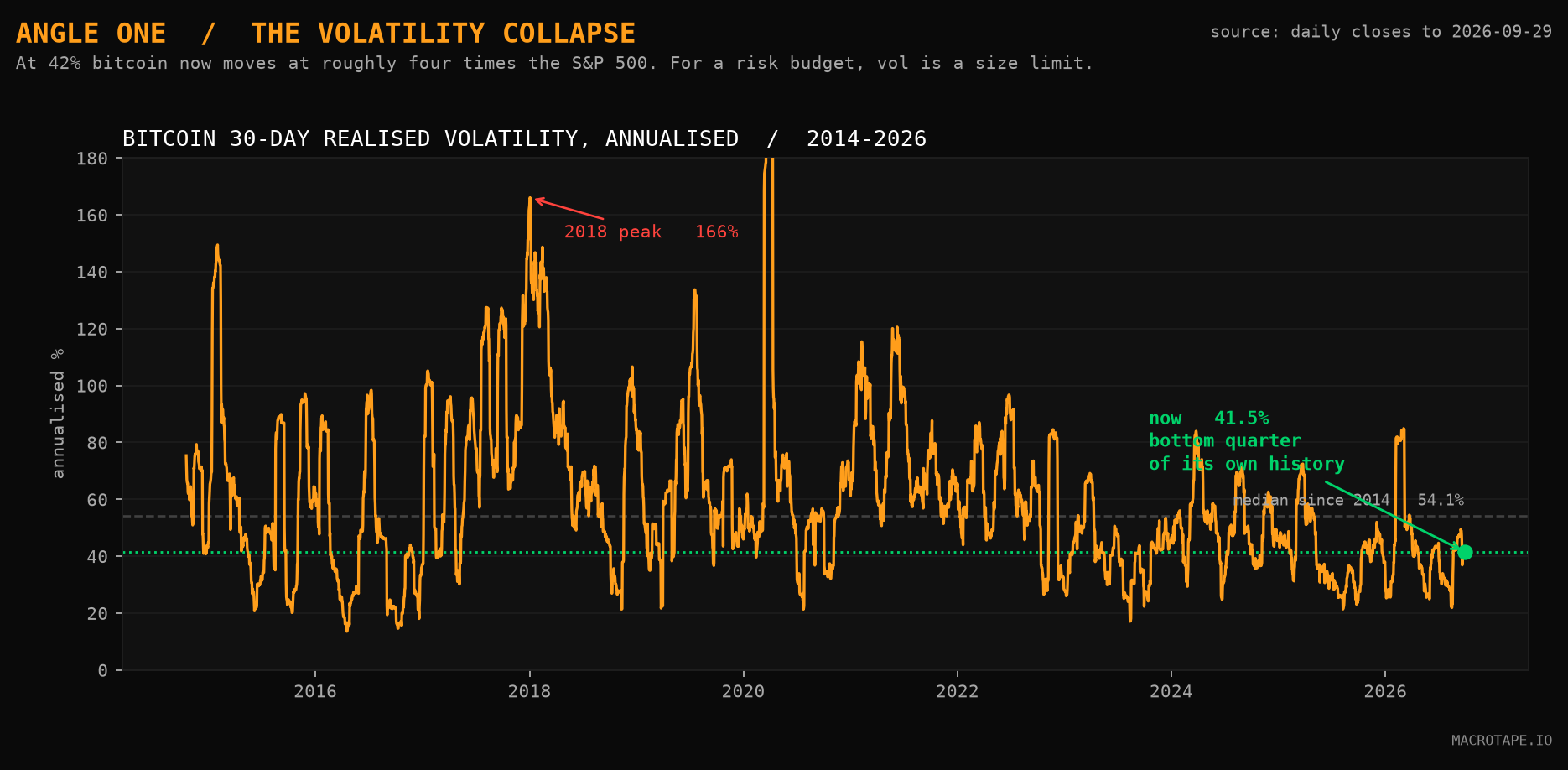
The longer windows agree. Ark Invest put 1yr realised volatility near 42% at the end of the second quarter and described it as a multi-year low. BlackRock's US head of equity ETFs, Jay Jacobs, told clients in September that bitcoin volatility had fallen into a band of 35% to 40%, comparable to certain mega-cap technology stocks, and attributed it to the listed ETP complex, the arrival of listed options, and a base of owners who hold for longer than a quarter.
Set that against an S&P 500 running at roughly 11% realised and the ratio is under four. For most of bitcoin's life it sat between six and ten. The asset has quietly moved most of the way toward the volatility of the securities it is supposed to be uncorrelated with.
This matters because a volatility budget is not an abstraction. It is the line in a mandate that sets position size. An asset that moves at 42% rather than 90% earns roughly twice the weight for the same contribution to portfolio risk. The volatility fell. The sizing models were not rebuilt.
7 sessions of demand, 11 weeks of supply
Since the April 2024 halving the network creates 3.125 BTC per block. That is 450 coins a day, 3,150 a week, 164,250 a year. The schedule is fixed, published, and cannot be lobbied.
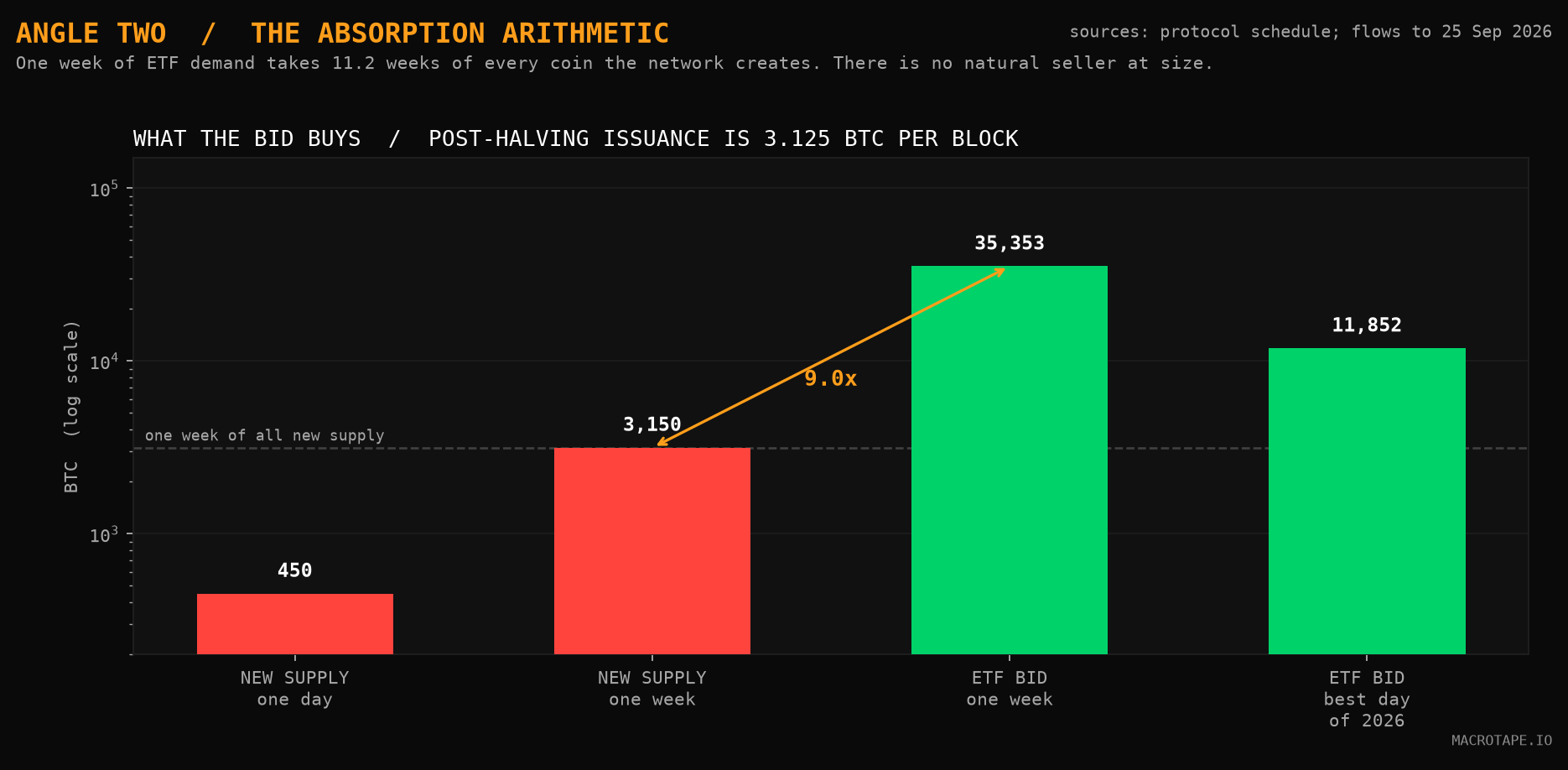
Across the 7 sessions to 25 September, US spot bitcoin ETFs took in approximately $2.98bn net, the strongest run of 2026. At a mark of $84,292 that is 35,353 coins. 7 sessions of fund demand absorbed 11 weeks of everything the network produced. The calendar week ending 25 September, a narrower window, drew about $2.4bn.
The strongest single session of 2026 was 21 September, at $999m, or 11,852 coins in a day. Cumulative net inflows into the US spot funds since their January 2024 launch are approximately $57.5bn.
The composition of the two sides of that trade is the part worth noticing. The issuance is sold by miners, who must sell to fund operations and are therefore acutely price-sensitive. The demand arrives through allocation decisions, which are largely price-insensitive: a 1% weighting is a 1% weighting whether the asset is at 84,000 or 124,000.
Flows this year turned positive only on 22 September. They had bottomed at minus $5.69bn on 13 July. That is the point rather than a footnote to it: the bid came back after the drawdown, not before it.
It is not a rates trade
The accepted explanation for bitcoin's 2026 decline is the rise in long yields. The data does not support it.
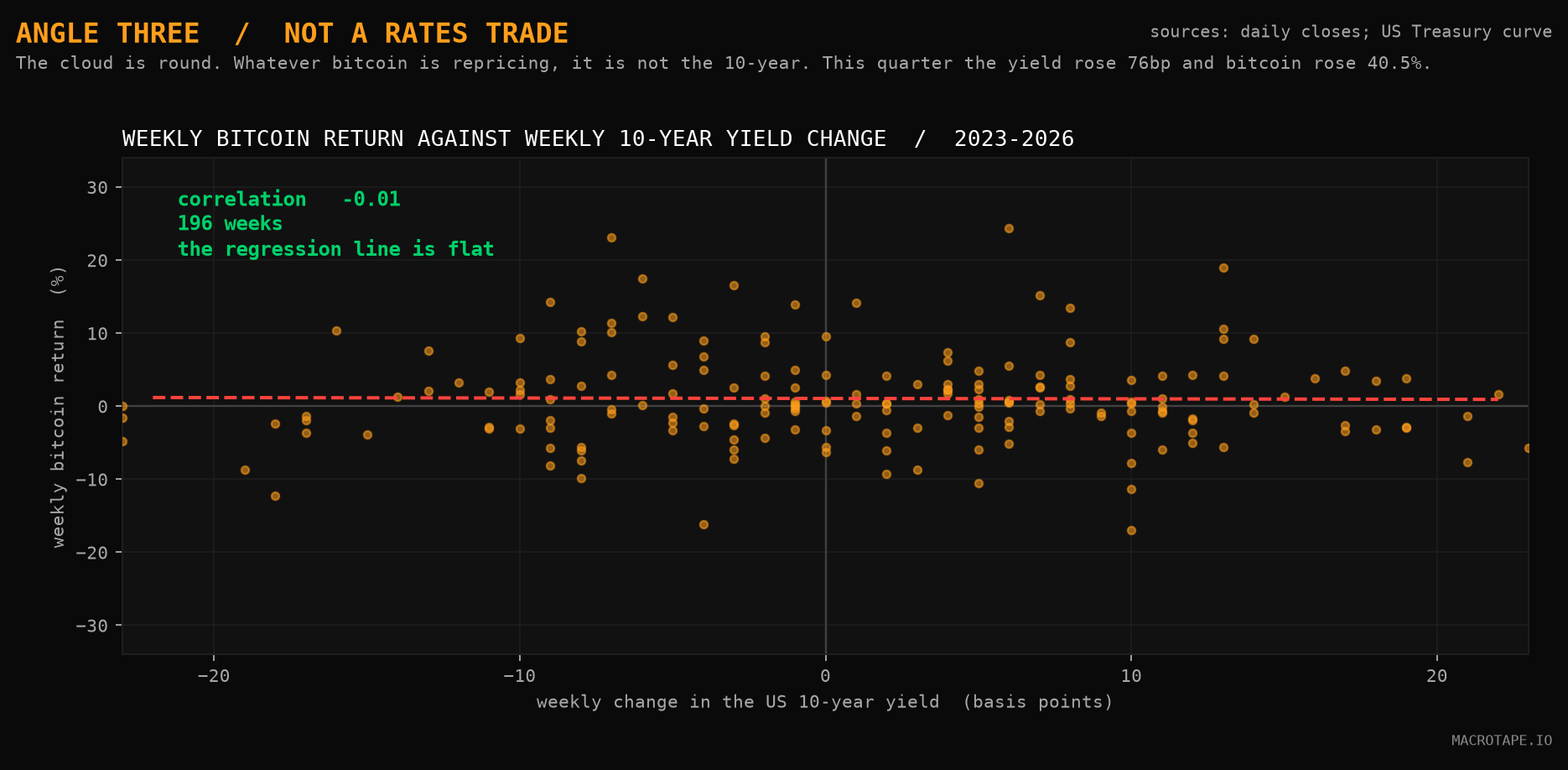
The weekly correlation between bitcoin's return and changes in the US 10yr yield, from 2023 through today, is minus 0.01. Across 196 weeks. Year by year it reads minus 0.15, plus 0.07, plus 0.06 and plus 0.11. Not negative. Absent.
This quarter is the natural experiment. The 10yr ran from 4.48% to 5.24%, a move of 76 basis points, and bitcoin rose 40.5% over the same window. Gold rose 2.5%. Both stores of value appreciated into a rising discount rate, which is not what a duration asset does.
If bitcoin is not a duration asset, two things follow. A portfolio holding it as a hedge against long-end yields has mislabelled what it owns. And a portfolio excluding it because yields are rising is excluding it for a reason that does not survive contact with the series.
Digital credit: the claim you are paid to hold
Strategy Inc holds 847,666 bitcoin, worth about $71.45bn at a mark of $84,292. Against that sit roughly $6.70bn of senior unsecured convertible notes, ranking first, and four series of perpetual preferred stock beneath them. The company adopted a capital framework in June 2026 and named the whole layer digital credit.
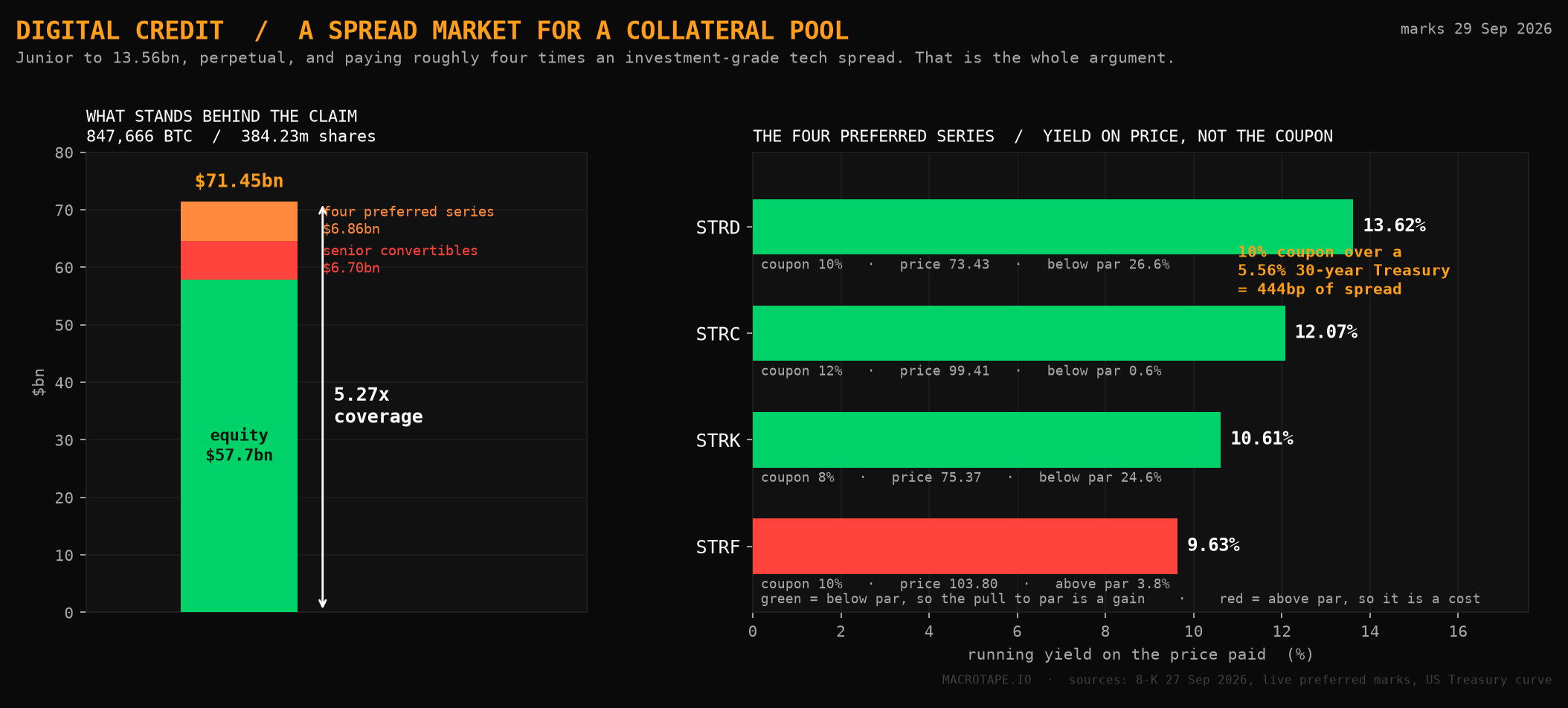
The preferreds are where the market has been forced to state its view in numbers, because unlike the convertibles they trade in size every day.
STRD carries a $10.00 coupon and is marked at 73.43, for a running yield of 13.62% and a discount to par of 26.6%. STRC carries a $12.00 variable coupon and is marked at 99.41, for a running yield of 12.07%. STRK carries an $8.00 coupon alongside a conversion feature and is marked at 75.37, for a running yield of 10.61% and a 24.6% discount to par. STRF carries a $10.00 coupon and is marked at 103.80, for a running yield of 9.63% and the only premium to par of the four.
The comparison that matters is not against other bitcoin instruments. It is against the alternative a credit buyer actually has. A 10% coupon over a 5.56% 30yr Treasury is 444 basis points of spread. For that, the buyer takes a perpetual claim, cumulative but junior to the convertibles, with no maturity date and no covenant, on a collateral pool that is marked daily and disclosed publicly.
For a similar handful of hundred basis points over Treasuries, an investment-grade technology issuer with a real maturity and a real covenant sells paper to fund data centres. The market is charging the bitcoin collateral pool, where every coin is verifiable by anyone at any hour without asking management, roughly what it charges a credit whose collateral is a contract with a hyperscaler.
There is a second point, and it cuts the other way from the equity. As the projection work on this site has shown, with share accretion at zero the common equity's outperformance is a bet on the multiple re-rating rather than on the coin compounding. The preferreds are the opposite trade. They are the claim that is being paid to wait.
What unblocked the bid
The operational reasons an institution could not hold bitcoin have been removed one at a time over 20 months, and the sequence is worth recounting because it is the mechanism behind everything above.
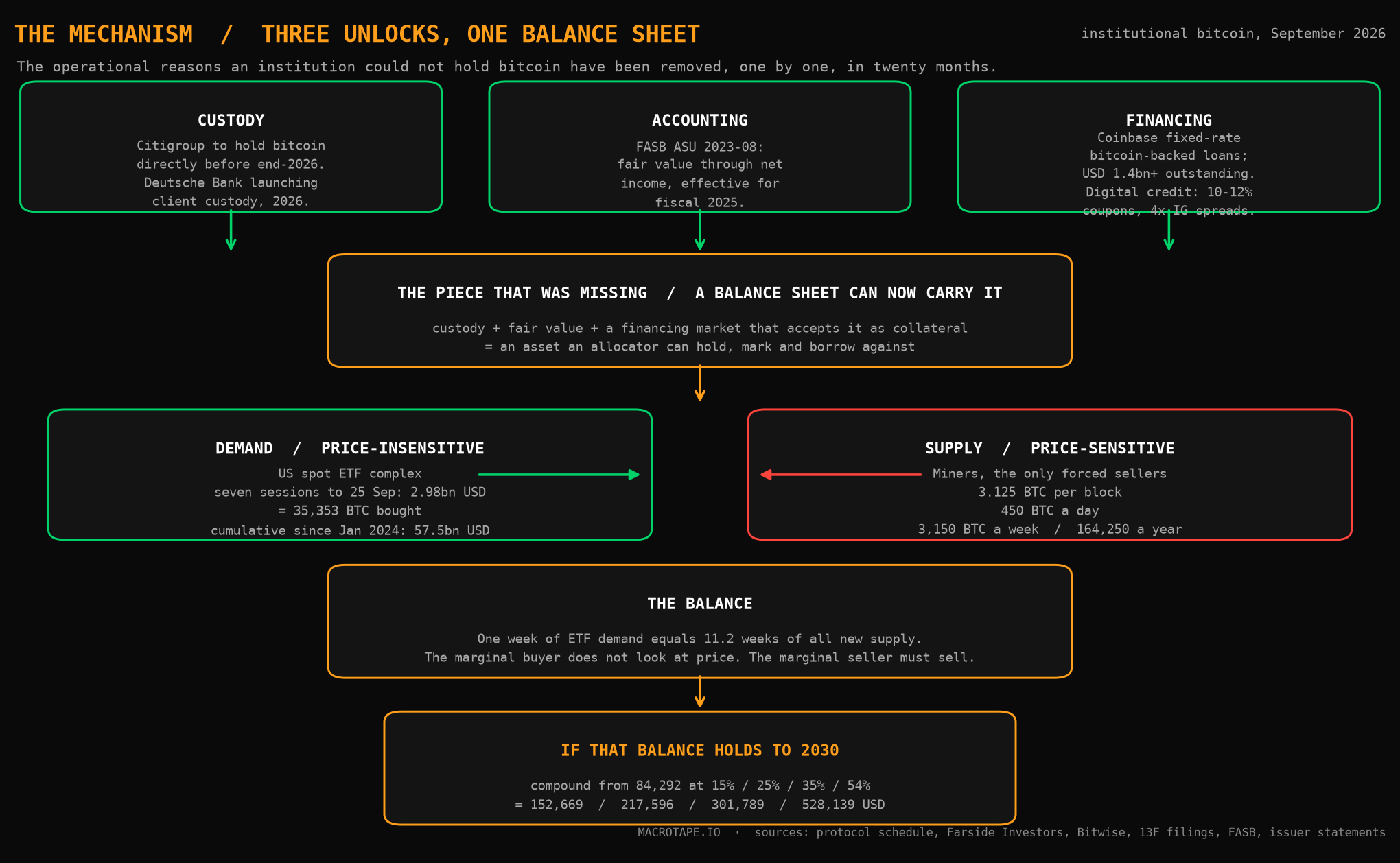
Custody first. Citigroup confirmed in August that it will hold bitcoin directly for clients before the end of 2026. Deutsche Bank announced in September that it will launch digital asset custody for institutional and corporate clients, with first clients in 2026.
Accounting second. FASB ASU 2023-08 requires in-scope crypto assets to be measured at fair value with changes recognised in net income, effective for fiscal years beginning after 15 December 2024. The SEC rescinded SAB 121 in January 2025. Bitcoin on a balance sheet is now marked rather than impaired, which removed the accounting penalty for holding it through a drawdown.
Financing third. Coinbase launched fixed-rate, fixed-term bitcoin-backed loans in September, alongside a variable-rate book with more than $1.4bn outstanding, and unified cross-margin across spot and derivatives at its prime brokerage.
Custody, fair value, and a market that accepts the asset as collateral is what a balance sheet needs to carry a position. The obstacle was never conviction. It was plumbing.
The early evidence is that the plumbing is being used. Bitwise interviewed senior allocators at 15 large institutions in March and April 2026. None reduced its allocation through a drawdown of roughly 50% between the fourth quarter of 2025 and the second quarter of 2026; several added. Every institution that holds crypto holds bitcoin, and for nearly all of them it was the first, largest and longest-held position. Mubadala Investment Company disclosed 14,721,917 shares of IBIT, worth $490.1m and 1.41% of its reported portfolio, in its second-quarter filing in August.
What would prove this wrong
Four facts are not a forecast, and the case against belongs in the same document as the case for.
Bitcoin is 32% below its October 2025 high of $124,753. It lost 23.1% in the first quarter and 14.0% in the second. Volatility at a historical low is still roughly four times that of the S&P 500, and a low percentile is a statement about the past, not a floor.
The preferred marks are themselves information, and they do not all say the same thing. STRF trades above par because the market trusts that claim. STRD trades 26.6% below par because it does not. A 13.62% running yield is not income; it is compensation, and a buyer should be able to state precisely what for. Both series are perpetual, both are cumulative, both rank behind the convertibles, and neither has any claim on the coin itself, only on the issuer that holds it.
Institutional ownership is a two-way door. The allocators who did not sell into a 50% drawdown have never been tested by a drawdown that follows a completed bull cycle, and the flow record shows how fast the bid reverses: $5.69bn of net outflows between January and mid-July of this year.
And bitcoin does not exist apart from the funding conditions of the assets beside it. A shock in the artificial-intelligence capital-expenditure complex, which is now the largest marginal borrower in credit markets and is already widening against the index, would not spare a risk asset with four times the index's volatility.
The arithmetic of the bull case, stated plainly so it can be checked: from $84,292, compounding to the end of 2030 at 15%, 25%, 35% and 54% a year gives $152,669, $217,596, $301,789 and $528,139. The 54% figure is bitcoin's 12yr realised rate. The 15% is below every rate the asset has compounded over a full cycle.
Where the Risk Lives Now — the credit backdrop the AI capital-expenditure complex is funded from
Five Names, One Ladder — the preferred structure this digital-credit layer runs on