The Spread Inverted. Greece Now Borrows Cheaper Than France.
A spread is the difference between what two governments pay to borrow over the same period. For a decade the euro-area spread ran one way: Germany cheapest, then France, then the periphery - Greece paying the most of the four. That order made sense. It priced the belief that the core could not default and the periphery could.
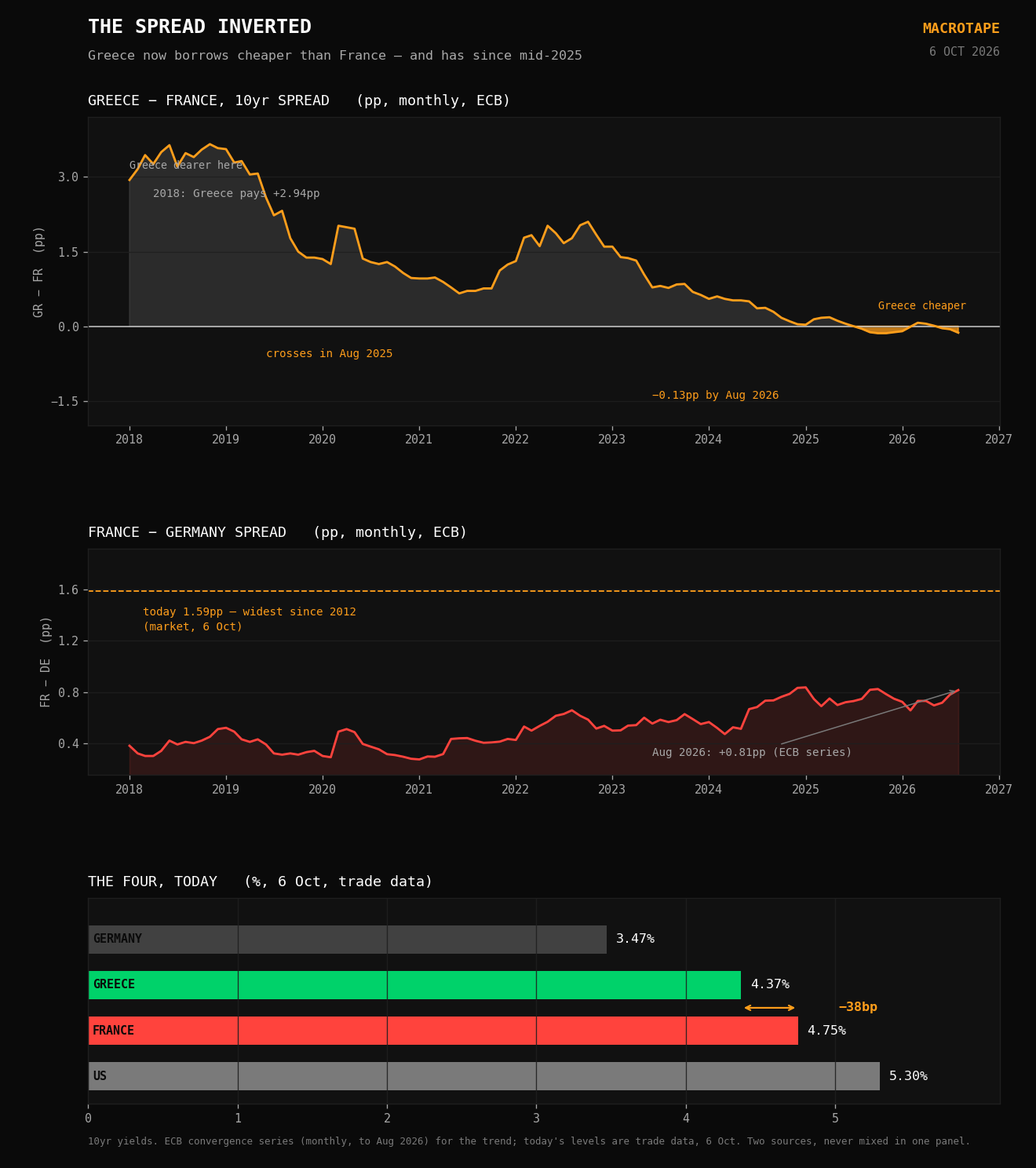
On 6 October the order is broken. Greece's 10yr yields 4.37%. France's yields 4.75%. Greece, a country that restructured its debt twice inside living memory, borrows 38bp cheaper than the second-largest economy in the euro area.
The claim this piece tests is narrow. The inversion is not a Greek triumph. It is a French repricing, and it says the euro area no longer has a risk-free core in the place it used to.
The measurement
The four 10yr yields on 6 October, per trade data: United States 5.30%, France 4.75%, Greece 4.37%, Germany 3.47%. The Greece-to-France spread stood at minus 37.8bp on 5 October, per the same source. The OAT-Bund spread reached 1.59 percentage points on 6 October, the widest since 2012, per Bloomberg.
A caution on the chart that prompted this piece. Its source notes state that the yields are user-supplied and unverified. The direction it shows survives the check. The figures do not all reconcile with trade data, so this piece uses its own and states the window, which is the rule here.
One line matters more than the rest. The Greek 10yr sits 38bp inside the French. The country that was the euro crisis yields less than the country that is now its problem.
What France did
France runs a deficit of about 5.4% of GDP. George Moran and Peter Schaffrik at RBC Capital Markets traced the swelling to a single decision, the 2018 cut to employer social-security contributions, and wrote on 5 October that France cannot fix the position with a one-off budget.
The politics removes the repair. The presidential election is more than 6 months away, with Marine Le Pen and Jean-Luc Melenchon leading the field and centrist parties losing ground. The government is trying to pass a budget against hostile lawmakers, and high-school students and public-sector workers are on the street.
The market has priced the argument into the banks before the sovereign. The cost of insuring EUR10mn of Societe Generale debt for 5 years rose to EUR103,000 a year on 5 October, about EUR16,500 more than comparable Deutsche Bank debt, per Bloomberg. In late August the two cost the same.
What Greece did
Greece has done the opposite. Debt-to-GDP was 146.1% in 2025, is projected near 136% in 2026, and below 120% by 2029, on the back of debt reduction and early repayments.
The rating agencies have followed. Scope upgraded Greece one notch to BBB+ in September 2026 with a stable outlook. Moody's kept Baa3 in the same month and moved the outlook to positive. Fitch affirmed BBB with a stable outlook in May 2026, its third upgrade since 2022.
None of that makes Greece a low-debt country. It makes it a country whose debt is falling, inside a currency union that has shown it will backstop a member state. The market prices the trajectory and the creditor, not the level.
The counter-evidence, stated plainly
Greece's debt burden is still worse than France's in absolute terms. Greece owes roughly 136% of GDP. France owes roughly 116%. On the level, France is the stronger credit and the market knows it.
So the inversion is not a claim that Greece is safer in a default. It is a claim that two things have changed. Greece is improving under a framework that has already been tested and defended. France is deteriorating under a parliament that cannot agree a budget. Both are statements about direction.
The magnitude is small and it can reverse. A credible French budget, or an ECB backstop, closes 38bp quickly. The size of the inversion is not the signal. The fact of it is.
Why the core matters
The euro area priced itself for a decade on a single assumption: that risk could not live in the core. Germany and France were where the safe money went, and the periphery was where it was paid to go. That assumption is now priced as false. Germany still borrows at 3.47%, but France no longer sits beside it.
On 6 October Le Pen called on the European Central Bank to lower borrowing costs to give member states room to invest. That is the political form of the same fact. When the fiscal tool is stuck, the pressure migrates to the central bank, and the market starts pricing the central bank's independence rather than its target.
There is a Japanese leg to this. Japanese investors hold roughly $145bn of French government bonds, about 6.6% of Japan's foreign bond book, per Bloomberg. At a hedging cost near 2.9%, the hedged pickup over a JGB is about 40bp. Japan's 10yr yields 3.115%, the highest since 1996. France is where a repatriating creditor meets a widening spread.
The currency leg
On 6 October the euro traded at USD1.1254, up 0.28% on the day and near its weakest level since May 2025, per trade data. The dollar index held about 101.8 to 102.1, close to its strongest since April 2025.
The euro is doing the work the spread cannot. A currency union has no exchange rate between its members, so a member's adjustment has nowhere to go but its spread and its banks. When the spread cannot close, the pressure moves to the single currency, and the euro trades as the market's vote on the whole bloc rather than on any one member.
Barclays FX strategists, including Themistoklis Fiotakis, see downside for the euro even if France passes a budget, per a note on 4 October. That is the same logic as the spread. The market is pricing the structure, not the single event.
The comparison across three currencies is the piece. The yen is the carry valve, and it has stopped depreciating against the dollar at about 158 even as the Bank of Japan raised its policy rate to 1.25%. The euro is the fiscal valve, at its weakest since May 2025 while the ECB holds its deposit rate at 2.50%, effective 16 September, with markets pricing an 87% chance of no change at the 28 October meeting. The dollar is the term-premium valve, near its strongest since April 2025 because the long end pays for it.
Japan and France pull the euro in the same direction. Japanese investors hold roughly $145bn of French government bonds, and at a hedging cost near 2.9% the hedged pickup over a JGB is about 40bp. The position is sold and the yen comes home. Two of the euro's creditor bases are repricing the euro-area core at once.
The invalidation
This read is wrong if the OAT-Bund spread compresses below about 1.20 percentage points on a credible French budget. It is wrong if the Greece-to-France spread returns positive, whether on an ECB backstop or on a French election outcome the market accepts. And it is wrong if the inversion reverses on a euro-area-wide move rather than a French-specific one, which would say the market repriced everyone, not France.
Europe Is Repricing France, Not Importing a Crisis — the day the French leg was read as contained - and the level it was read at
The Marks Were the Product — the unstable-currency version of the same bind, where the cost of money surfaced in the funds rather than the sovereign