Bitcoin Treasuries Changed Engine. Here Is the New One.
A Bitcoin treasury company has one job: turn other people's money into bitcoin held for its shareholders. For 4 years there was one way to do it. Sell newly created common shares into the market and use the cash to buy coins. Shareholders accepted the dilution because they ended up owning more bitcoin per share, and bitcoin per share was the only scoreboard that mattered.
A second way has now been built on top of the first. Instead of selling shares, the company sells a preferred instrument: a perpetual claim that pays a fixed or floating dividend, ranked ahead of the common. The money raised buys more bitcoin, and the common keeps all of the upside. The company is no longer selling ownership. It is selling credit.
This piece explains the difference in plain language, shows what it does to the balance sheet, and marks what the filings already reveal about which model Strategy is running today. Two words do most of the work, and both are explained from scratch: amplification and convexity.
Two ways to buy coins with other people's money
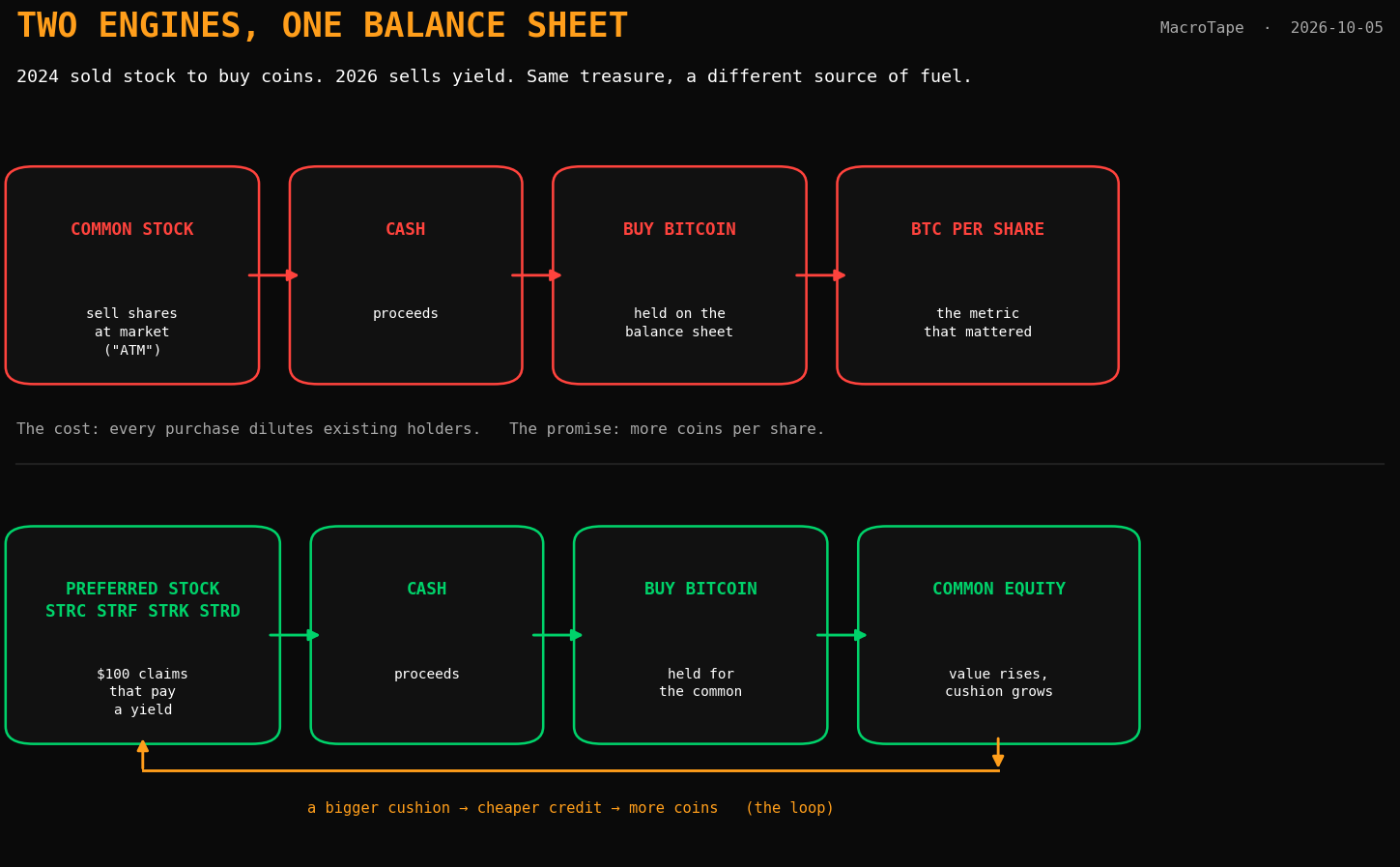
The top engine sold ownership. Every sale of new common shares spread the same pile of bitcoin across more shares, so the company had to keep buying enough coin to more than cover the dilution. The reward was bitcoin per share, and it was a good reward while the coins were cheap: buy 100 coins with the proceeds of shares equal to 80 coins of value and every holder is better off.
The bottom engine sells a promise instead. A preferred share is a fixed claim, usually with a listed dividend and a $100 face value. The buyer is not buying a piece of the upside; the buyer is buying a stream of payments, and a place in the queue ahead of the common if the money runs short. That is credit. Once a company can raise credit against its coins, it no longer has to dilute the people who own them.
The distinction matters because the two engines fail differently. The equity engine fails by dilution: the scoreboard stops moving even as the balance sheet grows. The credit engine fails by seniority: the payment is owed before the common sees a dollar, and it is owed every quarter whether the coin is up or down.
What changed is the source of the capital, not the destination
Both engines end in the same place. The proceeds buy bitcoin, and the bitcoin sits behind the common. What changed between 2024 and 2026 is where the money comes from, and that changes what the company is optimising for.
When the money comes from equity, the company is rewarded for issuing as much as it can, because every share sold is bitcoin added and bitcoin per share is the measure. The common stock is capped: it is the raw material being spent. When the money comes from credit, the company is rewarded for the opposite. A credit buyer wants a cushion. The deeper the equity beneath the preferred claim, the safer the claim, and the less yield the company has to pay for it.
So the objective flips. Under the equity engine the common is the currency to be spent. Under the credit engine the common is the collateral to be grown. A company that can raise credit against its coins wants its equity to be large and valuable, because that is what makes the next preferred safe enough to sell cheaply.
What the balance sheet looks like today
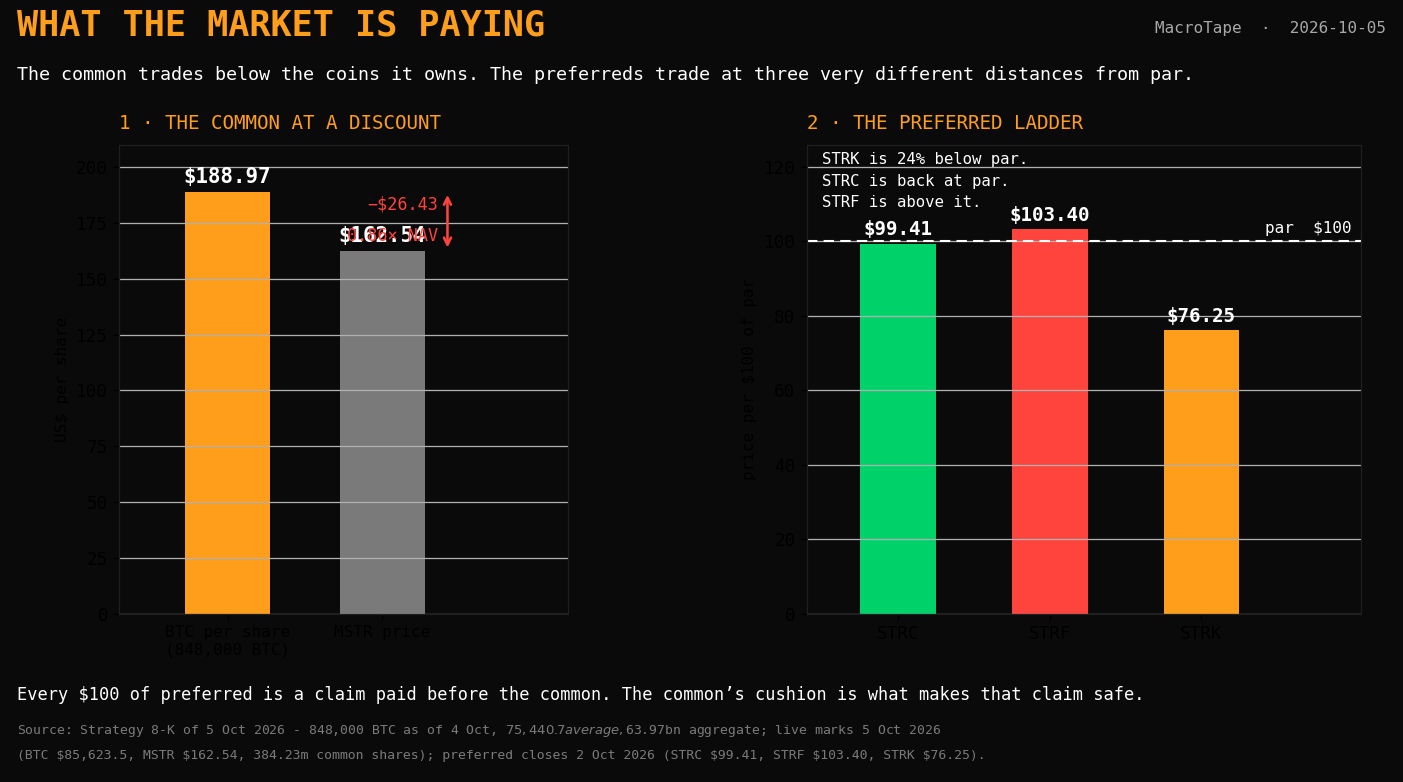
Strategy held 848,000 bitcoin as of 4 October 2026, bought at an average price of $75,440.7 for a total cost of $63.97bn, per the company's own 8-K of 5 October. With 384.23m common shares outstanding and bitcoin at $85,623.5, the coins behind each share are worth $188.97. The common trades at $162.54.
That is the single most important number on the page: the common is trading at 0.86 times the value of the coins it owns. A buyer of the common is paying 86 cents for a dollar of bitcoin exposure, and getting the operating business for free. The preferreds tell the other half of the story. STRC trades at $99.41, back at its $100 face value. STRF trades above par at $103.40. STRK trades at $76.25, 24% below the $100 it will be repaid at.
Three instruments, one issuer, three different prices for the same promise. The distance from $100 is what the market will pay for the claim today, and it is the clearest read available on how safe the market thinks the structure is.
Amplification, and then convexity
Two words carry the new model, and neither is jargon once it is unpacked.
Amplification is simply how much the share price moves for a given move in bitcoin. Bitcoin on the balance sheet divided by the value of the common is the ratio: if the coins are worth $72.6bn and the common equity is worth less than that, every 1% move in bitcoin moves the coin pile by more than the common is priced at. Add senior claims, and the common absorbs all of the change in the coin pile after the preferred dividend is paid, so it swings harder than the coin. That is leverage, and it is deliberate.
Convexity is the part that makes the model more than leverage. It is not a shape on a chart; it is a loop. A higher common price means a deeper cushion, which makes the preferred safer, which means the next preferred can be sold at a lower yield, which raises more money for the same promise, which buys more bitcoin, which raises amplification and the common price again. Each turn makes the next turn easier.
The loop is why the model is described as a flywheel rather than a ladder. It is also why it works in reverse. A bitcoin drawdown shrinks the cushion, the preferred gets riskier, the next issue costs more, the company buys fewer coins, and the loop turns against the common.
Why it accelerates
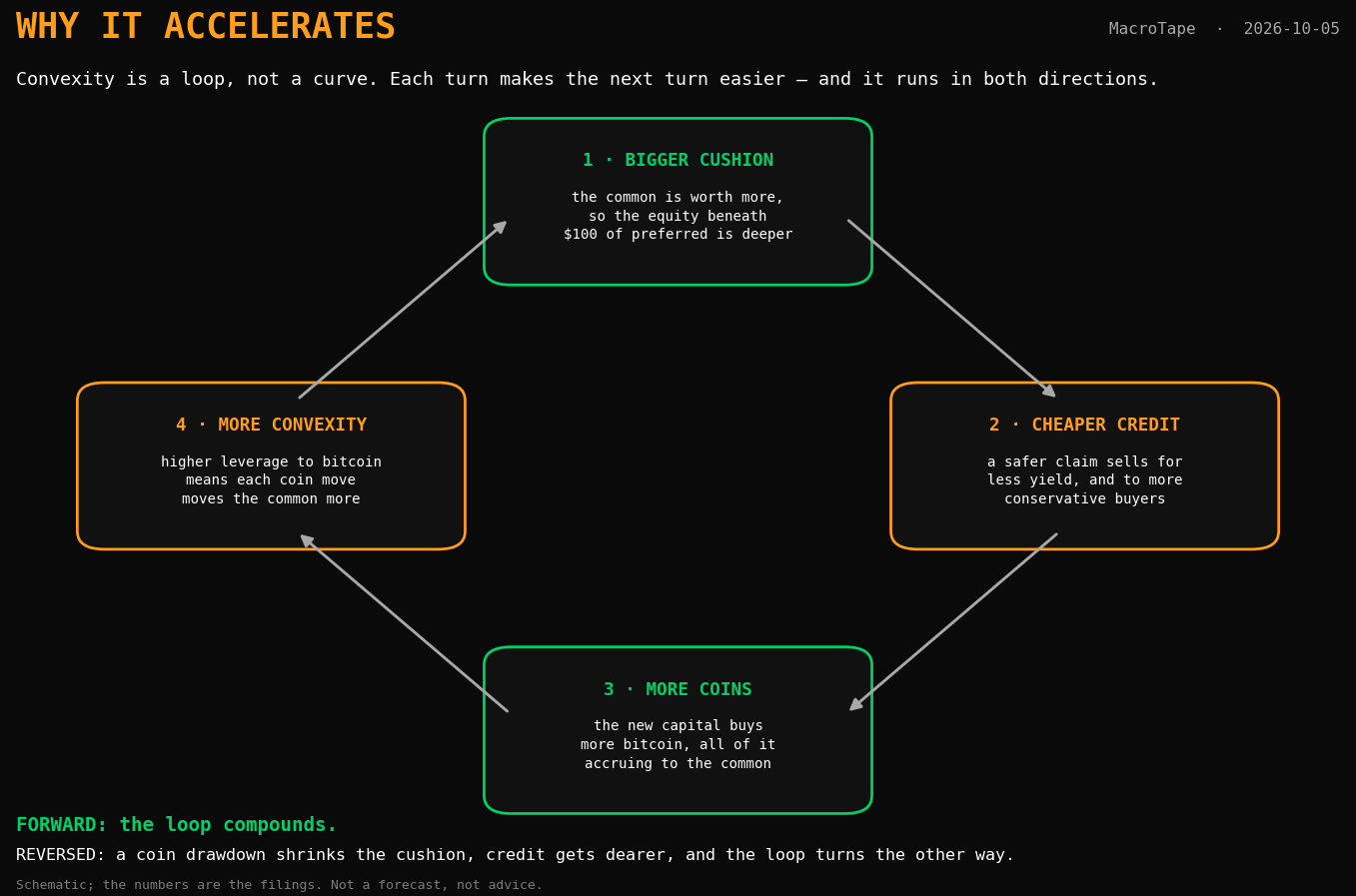
Put the four steps in order and the mechanism is visible. Cushion to credit to coins to amplification and back to cushion. Nothing in the loop is a forecast; it is a description of how the four quantities feed one another once a company is large enough to raise credit against its coins.
The practical consequence is the one the company's own behaviour points at. In the equity engine the share price was something to spend. In the credit engine the share price is the advertisement for the next preferred sale. A company that wants to sell $50bn of credit wants a large, expensive common behind it, because that is the cushion a conservative buyer is underwriting.
What the filings already show
The model is not a theory waiting to happen. Strategy's weekly filings of 5 October show which engine is running.
Under the at-the-market programmes, the common stock has been used sparingly: 92,894 shares sold for $15.7m of net proceeds in the last days of September. The preferred programmes carry the capacity instead, with $17.5bn available under STRC, $4.0bn under STRD, $2.1bn under STRK and $1.6bn under STRF.
More telling is the direction of travel on the existing claims. Strategy repurchased 1,033,168 STRC shares for $102.6m between 28 and 30 September, and a further 740,634 shares for $73.7m between 1 and 4 October, retiring almost 1.8m preferred shares in a week. A company buying back its own senior claims rather than issuing new ones is telling the market where it thinks the value is. It is the balance-sheet version of the argument in this piece: with the common below the value of the coins, retiring a $100 claim for less than $100 is accretive to the shareholders who remain.
The part that cuts the other way
Everything above is the mechanism, not a recommendation, and the mechanism has a sharp edge.
A perpetual preferred is credit, not a safe asset. The dividend is owed before the common is paid anything, it is cumulative, and it is junior to any debt. At a common price below the value of the coins, the company cannot sell new common to fund a shortfall without diluting the same holders it is trying to protect. A preferred trading below par is not a bargain; it is the market pricing the risk that comes with being first in line on a balance sheet whose collateral moves 50% a year.
The loop also depends on one assumption that a chart cannot show: that there are buyers for the credit. The whole model rests on demand for the preferred from investors who want yield and will accept bitcoin as the collateral behind it. If that demand thins, the flywheel slows to whatever the company can fund from cash flow and the equity market, which is the old engine, and the old engine dilutes.
What would change the read
The model turning is observable. Watch four things.
First, the multiple on the coins. A common trading below the value of its bitcoin is the condition that makes retiring senior claims accretive; a move back above 1.0 changes which engine pays. Second, the preferred ladder. STRC back at par while STRF trades above and STRK below is a market still choosing between the claims; a broad slide to discounts would say demand is thinning. Third, the flow of new preferred issuance against repurchases: net issuance is the credit engine running, net retirement is the balance sheet defending itself. Fourth, the size of the coins per share. If that stops growing, the newest engine has stalled and only the coin price is left doing the work.
The Power Law, Tested — the long-run path of the collateral every one of these claims is written against
Amplification and Convexity, in Plain English — the two words in this piece, defined from scratch with the arithmetic shown
What HY OAS Actually Measures — how a credit market prices the risk of not being paid, applied here to a coin-backed claim